 DWG
DWG
Piping Isometric Symbols — 150+ CAD Blocks for Isometric Drawings
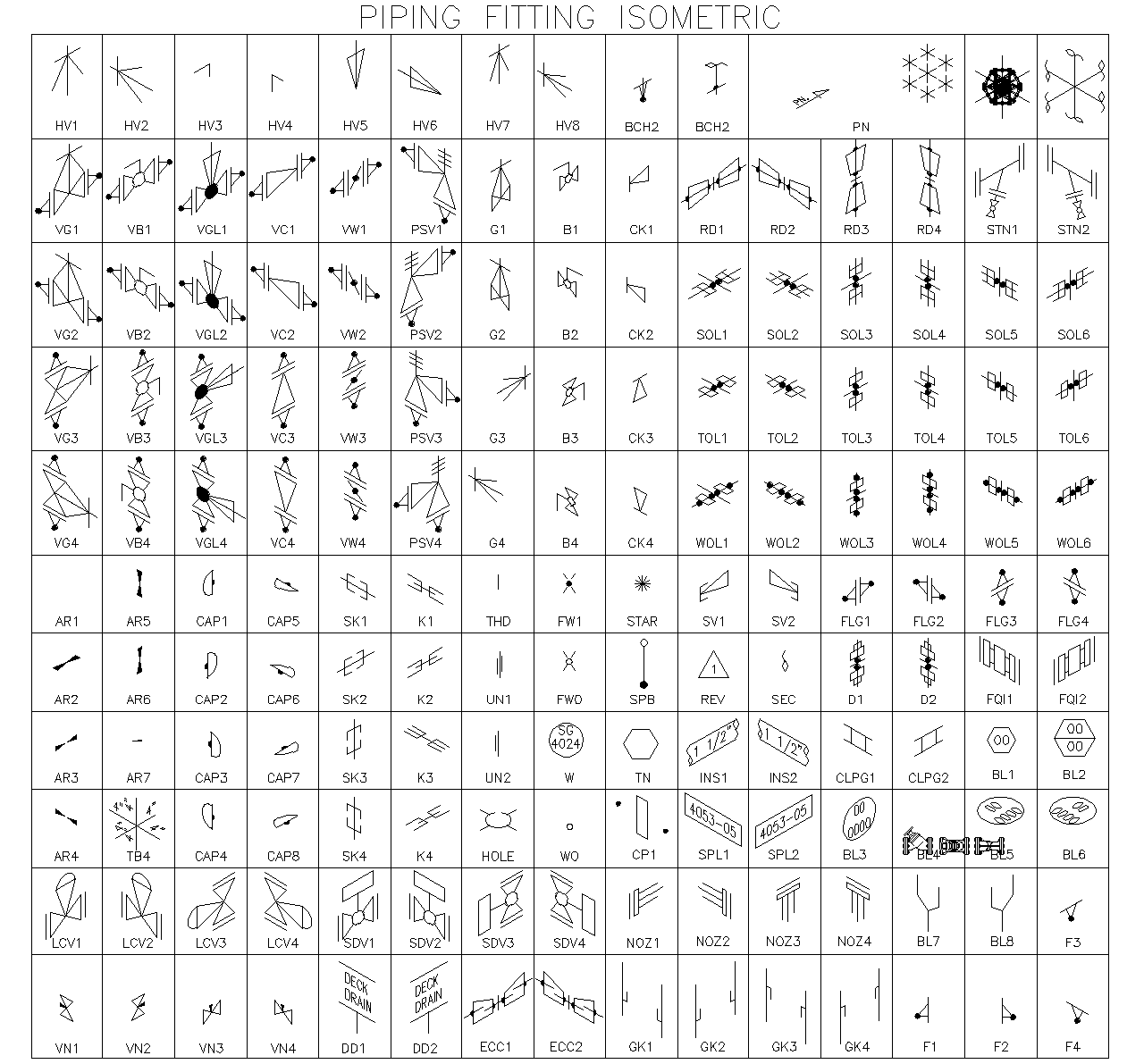
A sheet of over 150 isometric piping symbols — valves, olets, reducers, flanges, caps, supports and instrument marks — each coded for direct use on piping isometrics.
About
A single sheet carrying more than 150 isometric piping symbols, each coded and drawn at the same scale so they sit together on an isometric without adjustment. Everything a spool drawing normally needs is here: valves in all four orientations, branch connections, reducers, flanges, caps, supports and instrument marks.
What the sheet covers
- Valves — gate, ball, globe, check, needle, control and pressure relief, each drawn in four isometric orientations
- Branch connections — sockolet, thredolet and weldolet in six positions
- Reducers — concentric and eccentric, four orientations
- Flanges and joints — flanged, threaded, socket weld and union
- Caps and closures — eight variants
- Supports and guides — anchors, guides, spring supports
- Annotation marks — spool breaks, field welds, insulation tags, revision clouds, north arrows and continuation marks
How to use it
Isometric symbols only read correctly in the orientation they were drawn for, which is why most of these come in sets of four or six rather than one. Pick the one that matches the run direction rather than rotating a symbol to fit — a rotated isometric block reads as the wrong fitting to anyone checking the drawing.
The codes on the sheet are the block names as drawn. Keep the sheet itself in the drawing as a legend while you work, then move it to its own layer or delete it before issuing.
Symbol conventions are not universal. Check the set against the standard your project works to — a check valve or a reducer can be drawn differently between one company’s piping specification and another’s, and the drawing has to match what the fabricator expects.
Applicable standards
- ISO 6412 — Simplified representation of pipelines
- ASME Y14.5 conventions for dimensioning and annotation
- Check your project’s own piping specification, which usually overrides both