 DWG
DWG
Upright Sprinkler Installation Detail — Branch Line and Cross Main
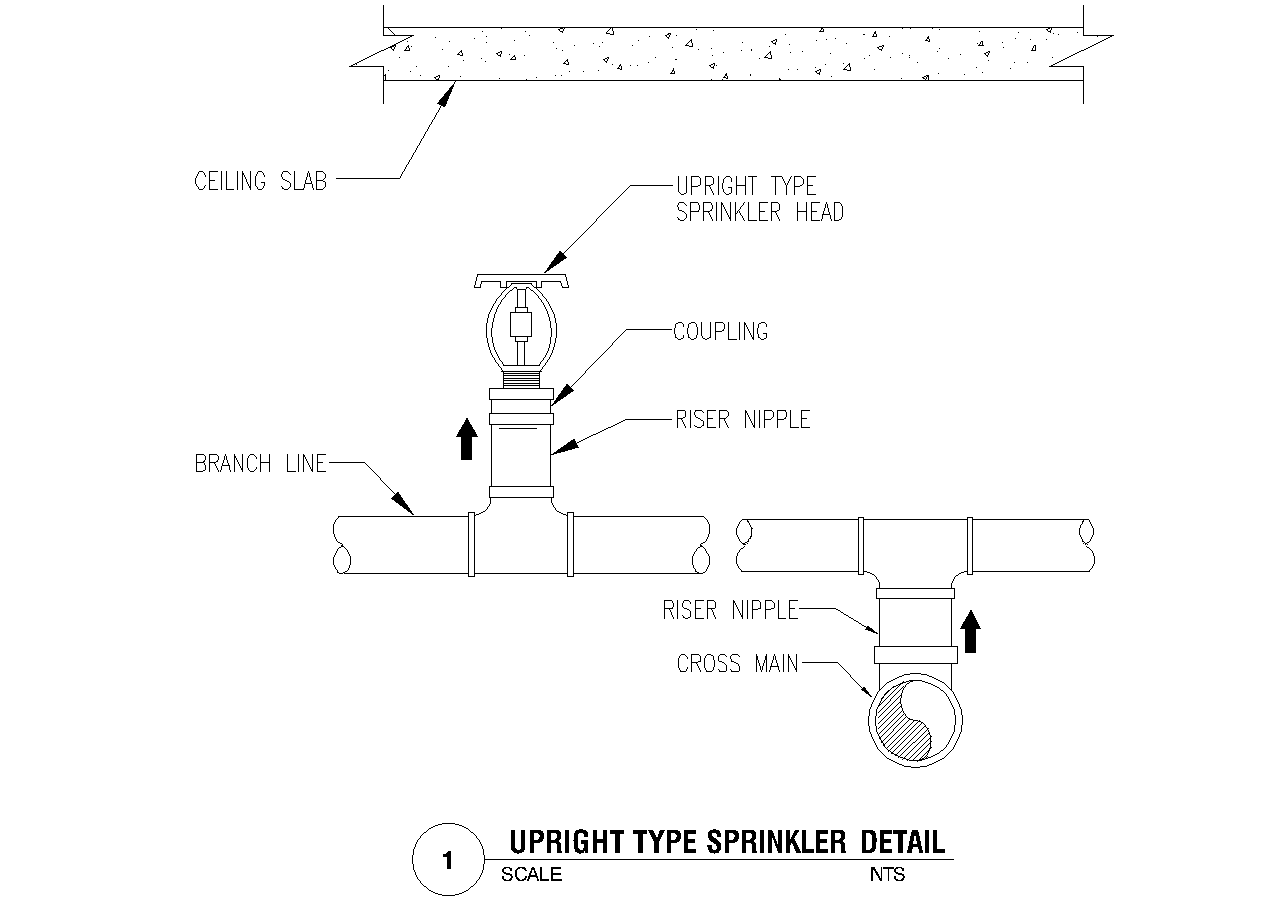
Upright sprinkler head installation detail showing the riser nipple and coupling arrangement on both a branch line and a cross main, with the ceiling slab above.
About
An upright sprinkler head shown in section with the ceiling slab above, drawn in the two arrangements the head is usually fitted in: rising from a branch line, and rising from a cross main.
What the detail shows
- Upright sprinkler head with frame arms and deflector
- Riser nipple and coupling to the branch line
- The same arrangement taken off a cross main
- Ceiling slab above, with the clearance to the deflector
- Flow direction on both arrangements
Installation notes
The distance from the deflector to the ceiling is the whole point of an upright head, and it is the thing most often got wrong. NFPA 13 sets a minimum and a maximum for standard spray uprights, and a head sat too close to the slab wets the ceiling instead of the floor. Confirm the figure for the head and the hazard classification actually specified.
Uprights are used where the pipework is exposed and the head has to sit above it — car parks, plant rooms, warehouses, anywhere without a ceiling to hide the branch line. Below a suspended ceiling you want a pendent head instead, which is a different detail.
The riser nipple length is set by the obstruction rules rather than by preference. A head sitting close to its own branch line is shielded by the pipe, so the nipple has to lift the deflector clear. This is where the detail earns itself: a fabricated spool with a nipple too short passes on the drawing and fails on site.
Keep the head clear of ducts, cable trays, lighting and any other service running below it. The obstruction rules are the most common cause of a sprinkler layout being rejected at review, and they are easier to solve on the drawing than on site.
Applicable standards
- NFPA 13 — Installation of Sprinkler Systems
- Check local Civil Defence requirements, which are often stricter on spacing and clearance than the code minimum